

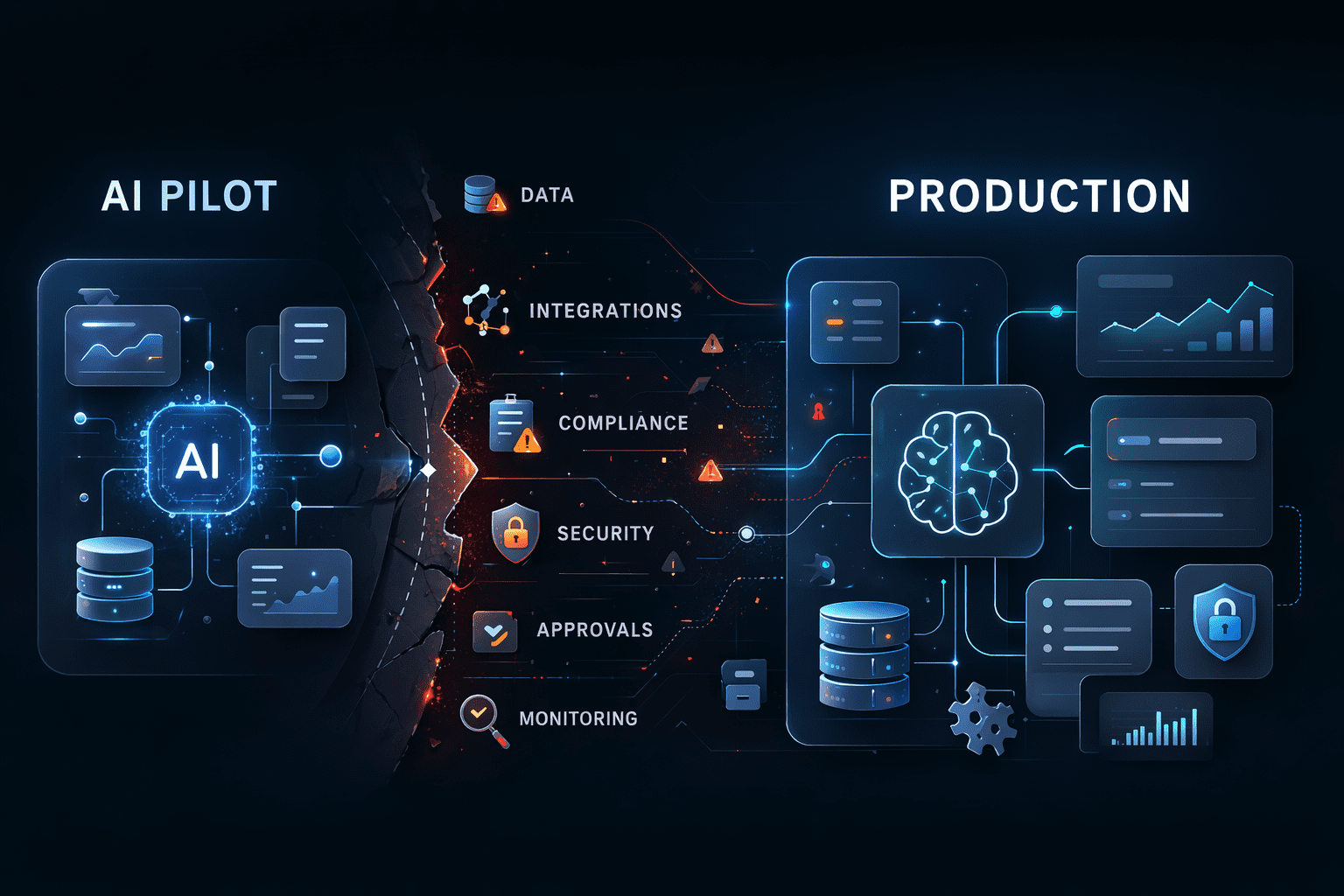
Many enterprise AI projects start with strong momentum and still never reach production, and that AI pilot to production gap is where many teams lose time, clarity, and rollout momentum.
That is the real AI pilot to production gap.
A pilot proves that an idea can work. Production proves that the system can work reliably inside real operations, with real users, live data, and business risk. Many teams build a good proof of concept but never build the delivery foundation needed to run it at scale.
In this guide, we explain why enterprise AI projects stall after the pilot phase, what changes between pilot and production, and what teams should do earlier to avoid getting stuck.
Learn more at Mickinsey’s Guide.
AI Pilot to Production: What Changes at Scale
A pilot runs in a controlled environment. The team uses a limited dataset, a narrow workflow, and a small group of users. That setup helps validate the concept quickly, but it hides the problems that appear later.
Production changes everything. The system now has to work with messy data, connect to real tools, handle edge cases, meet security requirements, and perform consistently over time. It also needs monitoring, fallback logic, and clear ownership.
That is why a successful pilot does not automatically become a production ready AI system.
Why AI Pilot to Production Efforts Stall
AI Pilot to Production Breaks Down at Integration, Compliance, and Ownership
Most enterprise AI projects do not stall because the model is weak. They stall because the surrounding system is not ready.
1. Data works for the demo, not for production
Pilots often use smaller, cleaner datasets. Production brings incomplete records, changing formats, duplicates, and missing context. Once the system meets real data, output quality drops fast.
2. Integration comes too late
A pilot can sit outside the business. Production has to run inside it. Teams often delay API connections, permissions, workflow logic, audit logs, and handoff paths until later. That delay creates rollout friction.
3. Evaluation stays too shallow
In a pilot, teams often review results manually and move on. In production, that approach breaks. AI systems need clear success metrics, test sets, thresholds, and ongoing monitoring.
4. Ownership is unclear
Many AI projects start as shared experiments across teams. That works early on, but production needs clear responsibility. Someone has to own performance, updates, incidents, and business outcomes.
5. Security and compliance arrive at the end
Teams often treat governance as a final checkpoint. In reality, it shapes architecture from the start. Access control, data handling, logging, approvals, and policy boundaries need to be designed early.
Table: Pilot Stage vs Production Reality
| Area | Pilot Stage | Production Reality |
|---|---|---|
| Data | Small and curated | Messy, changing, real world |
| Integration | Limited or mocked | Connected to live workflows |
| Evaluation | Manual review | Measured, monitored, repeatable |
| Security | Basic handling | Policy, logging, access control |
| Ownership | Shared or vague | Clear technical and business owner |
| Reliability | Short term success | Stable performance over time |
What Teams Should Do Earlier
Teams move faster when they design the pilot with production in mind.
Start with a business KPI, not just model output. Define success in operational terms. That could mean faster document handling, lower support load, higher booking rate, or reduced manual work.
Build the evaluation layer early. Use a test set that reflects real usage. Measure quality on the cases that matter. Set thresholds that tell the team when the system is ready to expand.
Connect to real workflows sooner. Even a narrow production style integration gives better signal than a polished standalone demo. This step reveals where latency, permissions, and process friction will hurt later.
Assign ownership early. One team should own technical reliability. One business owner should own the outcome. Without that structure, momentum fades after the pilot.
How Dev Entities Approaches Enterprise AI Delivery
Large organizations face a specific set of challenges when moving AI beyond the pilot phase. Legacy integrations, internal approvals, multiple stakeholders, and compliance requirements add complexity that small prototypes rarely expose.
At Dev Entities, we work with enterprise teams on the parts that usually cause delays during rollout.That includes data pipelines that connect with existing infrastructure, integrations with internal systems and workflows, evaluation logic tied to business metrics, security and access control aligned with enterprise policy, and deployment structures that fit internal IT governance.
We also help teams audit requirements before development starts. That includes interviewing stakeholders, speaking with technical teams, and understanding how the current process works across systems, approvals, handoffs, and edge cases. This helps surface operational gaps early and gives the project a clearer production path before engineering begins. This helps surface production risks sooner, keeps compliance and governance aligned with the delivery plan, and gives the project a clearer path from pilot to production.
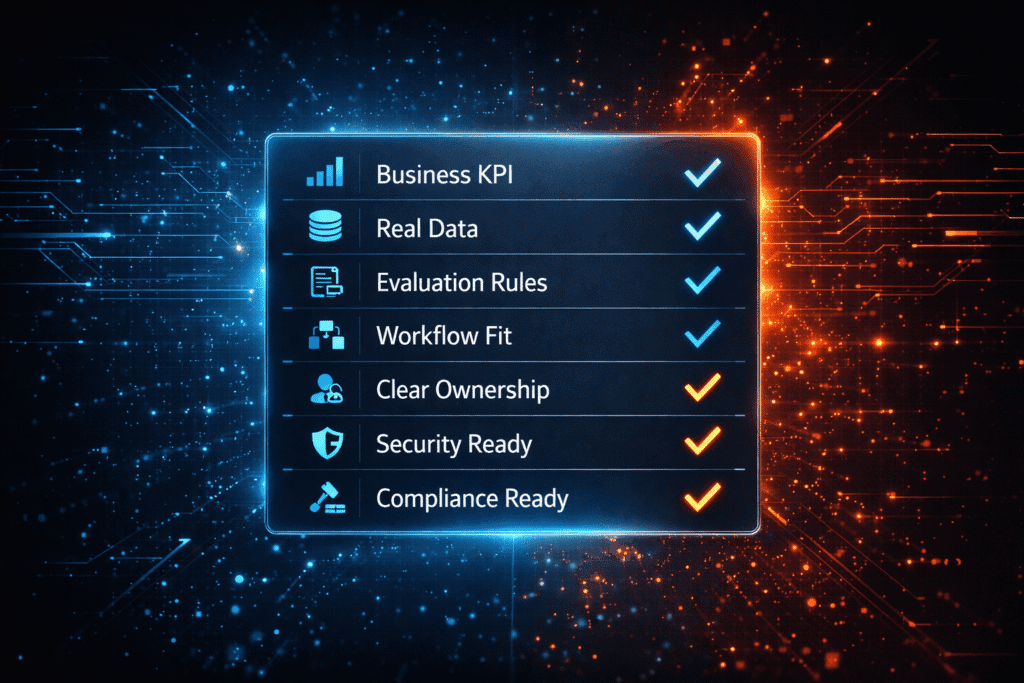
A Simple Production Readiness Check
Before scaling an AI pilot, teams should be able to answer yes to these questions:
- Do we have a clear business KPI tied to this system?
- Does the system use representative real world data?
- Have we defined evaluation rules and quality thresholds?
- Can the system connect to the workflow it needs to support?
- Is there a named owner for performance and rollout?
- Are security, logging, and approval steps already designed?
- Have we accounted for the compliance requirements this system will need to meet in production?
Final Thoughts
A successful pilot does not guarantee a successful rollout. Production requires more than model performance. It needs clean data, working integrations, clear evaluation, strong ownership, and governance that fits the business.
Enterprise AI projects stall when teams postpone those decisions. They move forward when teams design for production from the beginning and treat the pilot as part of a larger delivery plan.
Dev Entities is a US based software services company that helps enterprise teams move AI systems from pilot to production with the architecture, integrations, and delivery workflows needed for real business environments.
For teams evaluating coding agents or planning AI assisted engineering workflows, Dev Entities can help identify the right setup based on delivery style, control requirements, and product goals.