

If your business handles appointments, AI voice receptionist vs IVR is usually the decision you face once call volume grows. IVR reduces some workload, but it also adds friction for callers, which leads to hang ups, missed bookings, and staff still answering the same questions.
That is why AI voice receptionist vs IVR is a practical decision, not a trend decision. AI voice receptionists promise a more natural experience: callers speak normally, the assistant answers questions, handles objections, and books appointments. The real question is not whether AI sounds better, but whether it can reliably handle real calls with interruptions, clarifications, and edge cases.
In this guide, we break down AI voice receptionist vs IVR across cost, booking outcomes, and operational risk, then share a phased migration plan you can roll out without disrupting your front desk.
AI voice receptionist vs IVR: the real difference
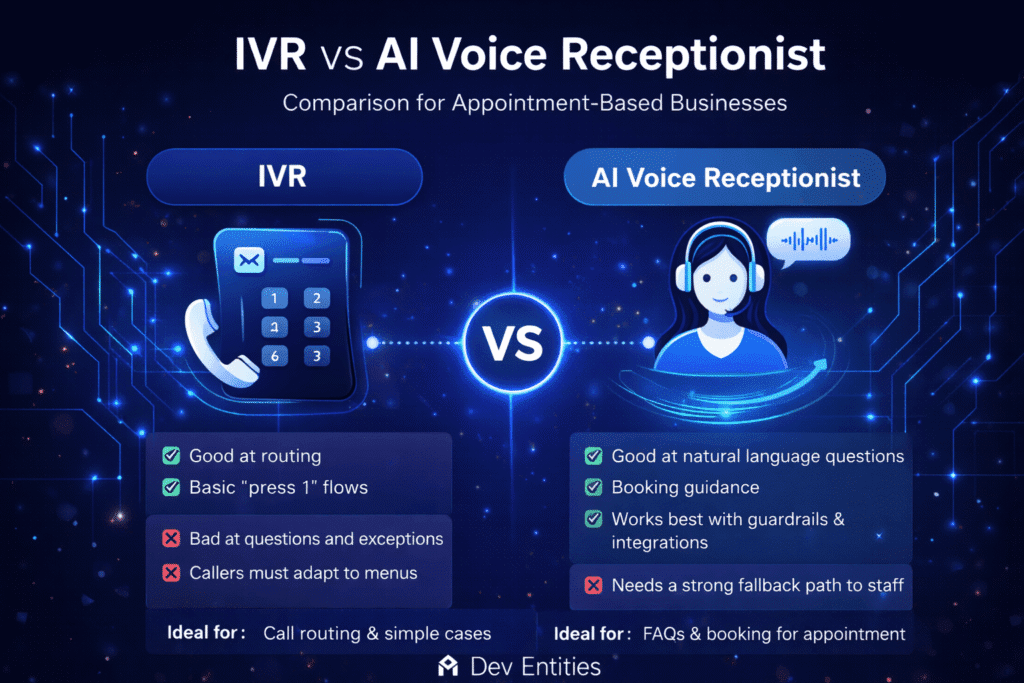
IVR is menu driven. It works best when your caller intent is simple and predictable. AI voice receptionists are conversational. They work best when callers ask real questions and want quick resolutions.
| Area | IVR (Menus) | AI Voice Receptionist (Conversation) |
|---|---|---|
| Caller experience | Press keys, follow menu prompts | Speak naturally, guided dialogue |
| Handles questions | Limited | Strong with guardrails and rules |
| Exceptions (reschedule, objections) | Often routed to staff | Can handle common cases, escalate cleanly |
| After hours capture | Usually voicemail or limited menu | 24/7 booking and FAQs |
| Best use case | Simple routing | Appointment businesses with frequent questions |
If callers often ask “Do you accept my insurance?”, “What are your hours tomorrow?”, “Can I reschedule?”, “How much is a session?”, IVR will push them to a human anyway. A well designed AI receptionist can answer fast or transfer with a structured summary.
Metrics that matter more than the tool
Before you pick a system, decide what you are optimizing.
Key metrics:
- Abandon rate: how many callers hang up before resolution
- Booking rate: completed bookings divided by booking intent calls
- Transfer rate: calls that still need a human
- After hours capture: bookings made outside business hours
- Average handle time: time to resolution
- Staff interruption rate: how often staff get pulled away
IVR can reduce handle time for routing, but it often increases abandon rate. An AI voice receptionist can reduce abandon rate and improve booking rate when the experience is smooth and the system handles interruptions and objections.
AI voice receptionist vs IVR: cost model, simplified
Cost is usually the decision trigger. Here is how to think about it.
IVR costs
- Setup fees plus phone system fees
- Maintenance when menus change
- Hidden cost: missed bookings and frustrated callers
AI voice receptionist costs
- Usage based minutes plus model usage and tool calls
- Integration work (calendar, CRM, booking system)
- Ongoing tuning and evaluation
A useful way to compare is cost per booked appointment, not cost per minute. If AI increases bookings and reduces staff load, it can be cheaper even when per minute costs look higher.
Why voice agents fail in the real world
Most failures are not “AI is dumb.” They are design problems.
- No interruption handling: caller interjects, the assistant loses track
- No objection library: “I need to speak to a human” is not handled properly
- No confirmation policy: booking without confirming date and time
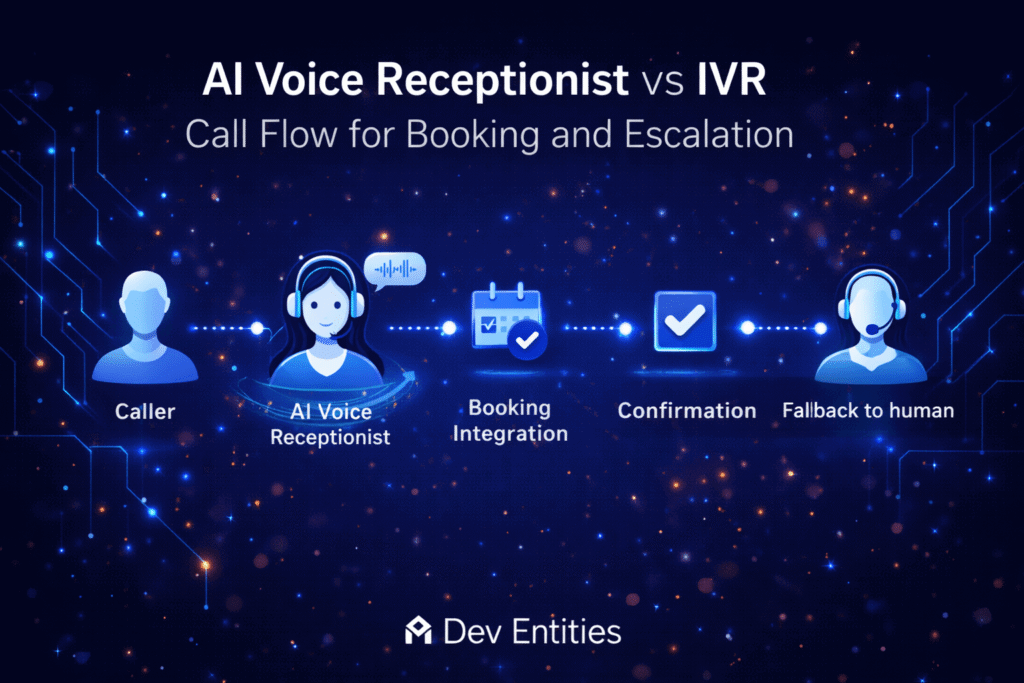
- No fallback: uncertain answers should transfer, not guess
- No integration: agent talks but cannot actually book, reschedule, or verify
A successful voice receptionist needs strict turn taking rules, confirmed slots, and graceful escalation. It should never confidently guess on business critical topics.
AI voice receptionist vs IVR: a safe migration plan
| Phase | What you automate | Goal |
|---|---|---|
| Phase 1 | Overflow and after hours | Capture missed bookings |
| Phase 2 | FAQs and pre qualification | Reduce staff interruptions |
| Phase 3 | Booking for simple cases | Improve booking completion |
| Phase 4 | Expand features | Reschedule, cancel, reminders, payments |
Do not replace your front desk on day one. Start with the calls you are already losing, then expand as performance proves itself.
Integration checklist
An AI receptionist is only as good as its integrations:
- Calendar or scheduling system (Google Calendar, Calendly, custom)
- CRM or patient system notes capture
- Business rules (hours, services, pricing, policies)
- Escalation to staff (warm transfer, voicemail, ticket)
- Call logging and analytics dashboard
- Compliance rules for recording and data retention based on your industry
Further reading
Dev Entities is a US based software services company that builds AI voice systems with production grade guardrails, interruption handling, and measurable booking outcomes.
Want to validate whether AI voice receptionist vs IVR makes sense for your appointment flow? Share your current call flow and a set of real call examples. We will propose a voice flow, a migration plan, and a cost model tied to booking rate.