

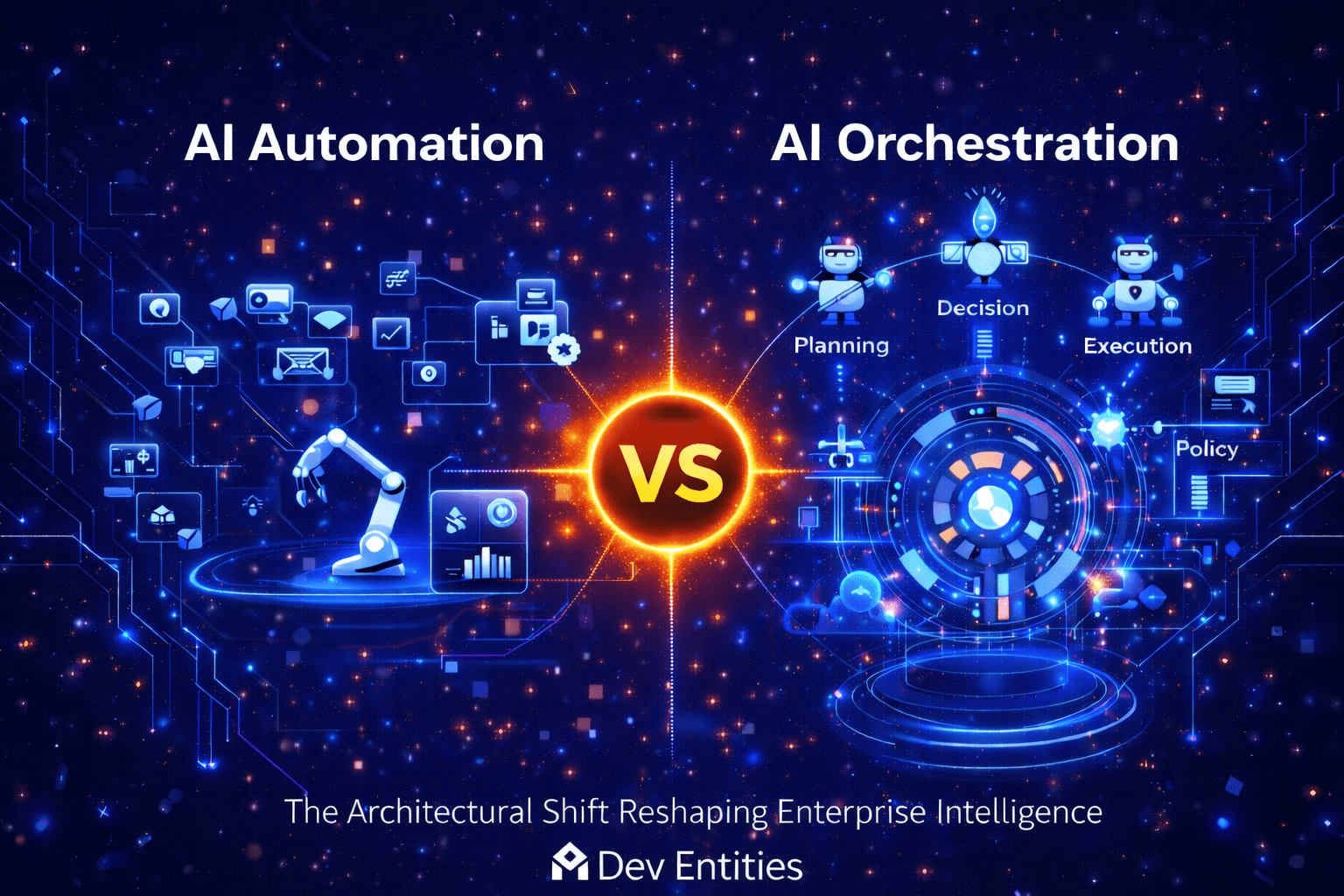
Enterprise AI strategy is entering a structural turning point as organizations shift from isolated automation toward AI orchestration. For the past several years, the dominant focus has been AI automation: using machine learning, large language models, and workflow engines to automate repetitive business processes. From automated customer support to AI driven document review and invoice processing, automation has delivered measurable gains in speed, cost efficiency, and operational consistency.
But in 2026, forward looking organizations are asking a deeper question: Is optimizing individual workflows enough to build enterprise intelligence at scale? As a result, the debate between AI automation and AI orchestration has become critical. While automation improves tasks, orchestration governs systems. In other words, automation embeds intelligence inside workflows, whereas orchestration positions intelligence above workflows, coordinating planning, decision making, execution, and governance across the enterprise.
As enterprise AI architecture evolves, organizations are increasingly comparing AI orchestration vs AI automation to determine which model supports scalable intelligence. While AI workflow automation improves operational efficiency, AI orchestration platforms introduce coordination across systems, agents, and governance layers. Understanding this difference is essential for designing sustainable enterprise AI infrastructure.
This shift is accelerating enterprise adoption of AI orchestration as the foundation of scalable AI architecture.
What Is AI Automation and AI Orchestration in Enterprise Architecture?
AI automation enhances execution by embedding intelligence directly into defined workflows. Its primary objective is to improve speed, reduce operational cost, and increase consistency. Architecturally, this approach remains workflow-centric intelligence optimizes individual tasks while the underlying process structure stays unchanged. As a result, AI strengthens how teams perform work without fundamentally changing how systems interact. This model works best in environments with structured, repeatable, and predictable processes.
AI orchestration operates at a different architectural layer. Instead of embedding intelligence inside individual workflows, it coordinates multiple AI systems, decision layers, and execution tools across the enterprise. Rather than improving how tasks run, orchestration governs how decisions align.
Where AI Automation Breaks Without AI Orchestration?
AI automation delivers measurable gains in speed, cost control, and operational consistency. At the task level, it is transformative. The challenge emerges when organizations try to scale intelligence across systems. Automation optimizes execution, but enterprise intelligence requires coordination. That distinction becomes visible only at scale.
1. Fragmented Intelligence
Automation improves local workflows.
- A support AI resolves tickets faster.
- A finance AI processes invoices more accurately.
- A compliance AI flags risky clauses more efficiently.
Each system becomes highly optimized within its boundary. Yet enterprise decisions rarely live inside a single boundary.
- Support decisions affect revenue.
- Finance decisions affect customer trust.
- Compliance decisions affect operational timing.
When AI systems operate independently, intelligence becomes siloed. As a result, the organization moves faster, yet decisions lack systemic alignment. The enterprise begins acting quickly, but ultimately, not coherently.
2. Static Decision Boundaries
AI automation depends on predefined logic.
Even with large language models, teams structure workflows around known triggers, defined paths, and bounded outputs. The system executes exactly what designers intend it to execute.
Enterprise environments do not behave that way.
- They are exception heavy.
- They are ambiguous.
- They are cross functional by nature.
For example, a procurement request may require risk evaluation, budget validation, legal review, and operational urgency assessment simultaneously. Therefore, that is not a single workflow; it is a coordination problem.
- Execution is linear.
- Enterprise decision making is not.
How AI Orchestration Solves Enterprise Coordination Challenges?
The comparison below illustrates why orchestration becomes necessary as enterprise AI scales.
| Enterprise Limitation at Scale | Automation-Centric Reality | Orchestration Advantage |
| Siloed Intelligence | AI optimizes individual workflows but lacks cross-functional awareness. | Establishes a coordination layer that aligns decisions across departments. |
| Rigid Decision Logic | Fixed workflows struggle with ambiguity and exceptions. | Enables dynamic decision-making based on intent and constraints. |
| Disconnected Context | Systems operate with isolated memory and lose continuity. | Maintains shared state and enterprise-wide contextual awareness. |
| Reactive Governance | Compliance is enforced after execution. | Embeds real-time policy validation within decisions. |
| Linear Execution | AI performs tasks but doesn’t collaborate across systems. | Supports multi-agent coordination across planning and execution. |
| Scaling Fragmentation | More automation creates more complexity. | Centralizes control through orchestration engines. |
| Limited Strategic Value | Gains efficiency without improving alignment. | Transforms AI into a system-level intelligence layer. |
This is where orchestration moves from concept to necessity.
From AI Workflow Intelligence to Enterprise AI System Intelligence
Enterprise work does not follow workflows. It revolves around decisions and naturally spans multiple functions.
Modern enterprises increasingly treat AI as a system-level capability rather than a workflow tool a shift also discussed in enterprise AI maturity research by Gartner.
Workflows are only the surface layer. Enterprise outcomes depend on how decisions align across finance, risk, operations, and leadership priorities.
AI automation accelerates execution within functions.
AI orchestration introduces a system-level coordination layer that aligns decisions across functions.
Architecturally, this introduces a coordination layer connecting:
- planning
- decision evaluation
- execution systems
- governance
Workflows become components.
Intelligence becomes the governing layer.
Automation improves how work moves.
Orchestration ensures it moves in the right direction.
This shift defines the future of enterprise AI architecture and scalable AI systems.
What Changes Architecturally
In workflow centric AI systems, intelligence is embedded inside processes. In system centric AI architectures, intelligence governs processes. That shift produces visible differences:
- Routing decisions across departments instead of isolating them within tools.
- Maintaining shared context rather than resetting memory between systems.
- Enforcing regulatory and policy constraints in real time rather than after execution.
- Synthesizing inputs from finance, compliance, risk, and operations before acting.
Automation improves how fast tasks are completed. Orchestration improves whether tasks align with enterprise intent.
One optimizes motion.
The other optimizes direction.
Strategic Implications for Enterprise AI in 2026
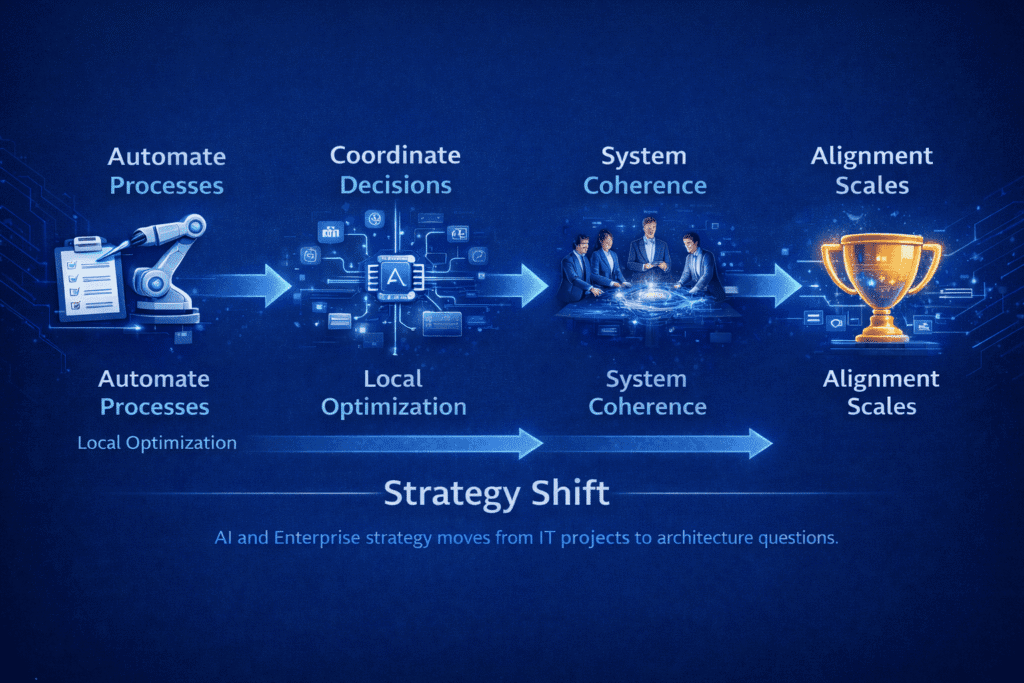
The shift from automation to orchestration is not a tooling decision. It is an architectural transition.
Leaders must rethink AI across three dimensions:
1. From Use Cases to Decision Systems
Design AI as an integrated intelligence layer, not a collection of automation projects.
2. From Workflow ROI to System Alignment
Task efficiency delivers short-term gains. Decision alignment creates long-term leverage.
3. From Tools to Coordination Infrastructure
Model selection matters. Intelligence flow matters more.
Enterprises that scale automation will gain speed.
Enterprises that architect coordination will gain coherence.
At scale, coherence becomes competitive advantage.
FAQ’S: AI Orchestration vs AI Automation
What is AI orchestration and how is it different from AI automation?
AI automation improves predefined workflows. AI orchestration coordinates decisions across workflows and systems.
Is AI orchestration replacing AI automation?
No. Orchestration builds on automation by introducing a coordination layer above workflows.
In 2026, enterprise competitiveness will depend not on how much AI is deployed, but on how intelligently it is orchestrated.